The global fertilizer industry is moving toward flexible, efficient, and demand-driven production models. Among the most practical solutions for regional distributors and agricultural suppliers is the 20-40TPH bulk blending fertilizer plant, a facility designed to deliver customized nutrient formulations with high throughput and relatively low operational complexity. Modern plants combine precision engineering, automation, and optimized material handling to achieve consistent quality while maintaining scalability.
Understanding the Bulk Blending Production Process
Bulk blending fertilizer production differs fundamentally from chemical granulation. Instead of creating nutrients through chemical reactions, the process physically blends pre-granulated raw materials such as urea, DAP, MAP, potash, and trace elements.
A typical workflow includes:
- Raw material receiving and storage – fertilizers are stored in separate bins or silos.
- Automatic batching and weighing – ingredients are proportioned according to preset formulas.
- Blending and homogenization – materials are mixed evenly without damaging granules.
- Packaging or bulk loading – finished products are prepared for distribution.
Because no drying or reaction stages are required, energy consumption remains low, making this model ideal for regional markets requiring rapid formula adjustments.
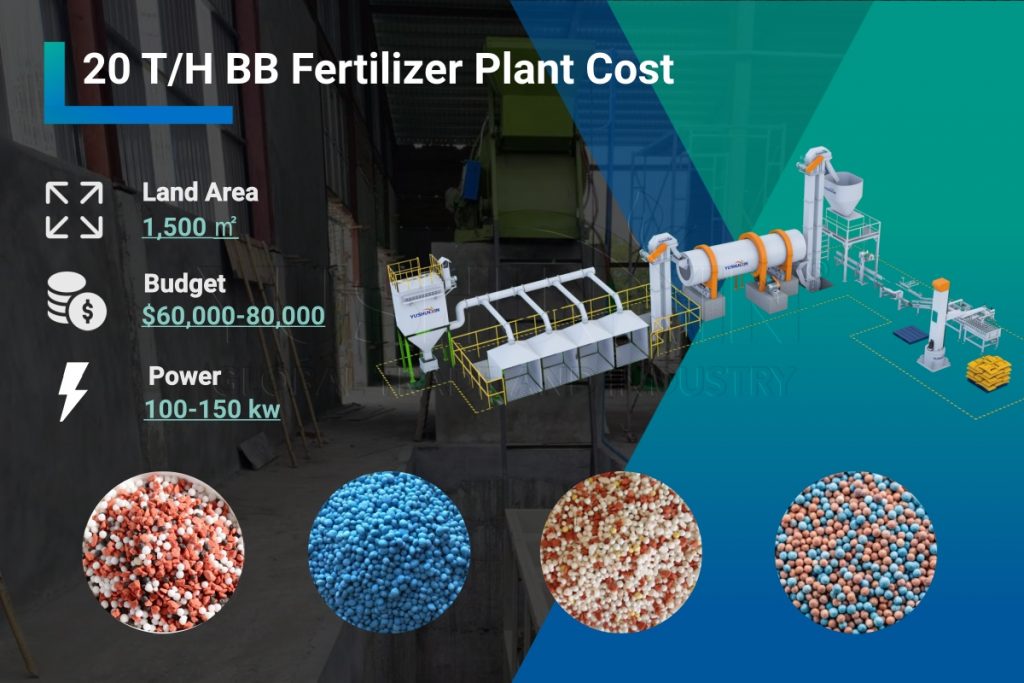
Core Equipment in a Modern Facility
A large scale BB fertilizer production line integrates several specialized machines working in synchronization. Each component contributes to accuracy, throughput, and operational reliability.
Key equipment typically includes:
- Bulk material storage bins with discharge control
- Belt or screw feeding systems
- Precision weighing hoppers
- High-efficiency mixers
- Conveyors and elevators
- Automatic bagging machines
- Dust collection systems
Equipment layout is carefully engineered to minimize segregation during material transfer, ensuring nutrient uniformity from start to finish.
Automation: The Engine Behind Efficiency
Automation has become the defining feature of modern blending plants. A fully integrated automatic fertilizer mixing system allows operators to control recipes, monitor production data, and adjust parameters through a centralized PLC interface.
Automation delivers several advantages:
- Accurate formulation with minimal human error
- Real-time production monitoring
- Reduced labor requirements
- Faster product changeovers
- Consistent batch repeatability
Advanced sensors and software also enable traceability, which is increasingly important for fertilizer distributors serving precision agriculture markets.
Turnkey Engineering and Project Implementation
Many investors prefer integrated solutions rather than sourcing equipment separately. A turnkey 30 TPH bulk blending fertilizer project typically includes plant design, equipment manufacturing, installation, commissioning, and operator training under a single contract.
This approach shortens construction timelines and reduces technical risks. Engineering teams optimize plant layout based on available land, logistics flow, and expected product portfolio, ensuring smooth long-term operation from day one.
Choosing the Right Technology Partner
Selecting an experienced fertilizer mixing system manufacturer plays a decisive role in project success. Beyond machinery supply, reliable partners provide process consulting, customization capabilities, and after-sales technical support.
Important evaluation factors include:
- Proven project references
- Automation integration expertise
- Equipment durability and maintenance accessibility
- Availability of spare parts and remote support
A strong manufacturer relationship helps operators adapt quickly as fertilizer demand patterns evolve.
The Future of Bulk Blending Fertilizer Plants
As agriculture shifts toward precision nutrient management, medium-to-high capacity blending factories are becoming essential infrastructure. Their ability to produce customized formulations efficiently positions them between small local mixers and complex chemical fertilizer plants.
With continuous improvements in automation, data integration, and material handling technology, modern bulk blending facilities are not only production units—they are flexible manufacturing hubs capable of responding rapidly to changing agronomic and market needs. If you plan to start the project, you can visit https://www.fertilizerbusinessplan.com/2024/03/13/20-30-t-h-bb-fertilizer-making-in-nigeria/
No Responses