If you want to turn poultry waste into marketable organic fertilizer, choosing the right granulation setup is essential. Different farms and fertilizer plants have different needs in terms of output, budget, labor, and product quality. A system that works well for a small poultry farm may not be suitable for a large commercial fertilizer producer.
Start with Your Production Scale
Before selecting equipment, you should first evaluate how much raw manure you can collect and process regularly. A small farm with limited manure output usually needs a compact chicken manure compost granulation system, while a larger plant may require a more complete and higher-capacity solution.
You should also think about whether your manure supply is stable throughout the year. If raw material volume changes often, your equipment should be flexible enough to handle those fluctuations.
Define the Fertilizer Product You Want
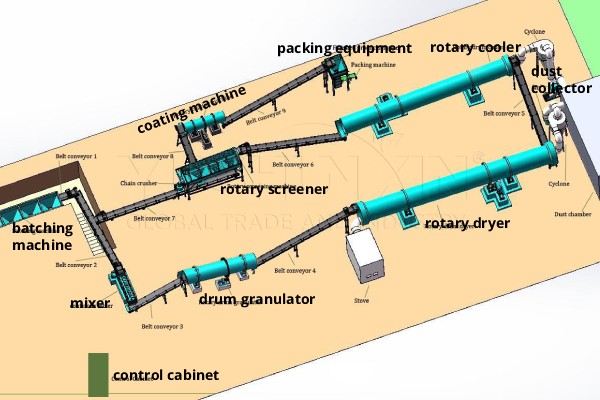
Not all organic fertilizer products are the same. Some buyers only need powder compost, while others prefer round, uniform granules that are easier to store, transport, and apply. If your goal is to produce premium pellet fertilizer, then your composted chicken manure granules production line should include not only granulation equipment, but also composting, crushing, screening, drying, cooling, and packing sections.
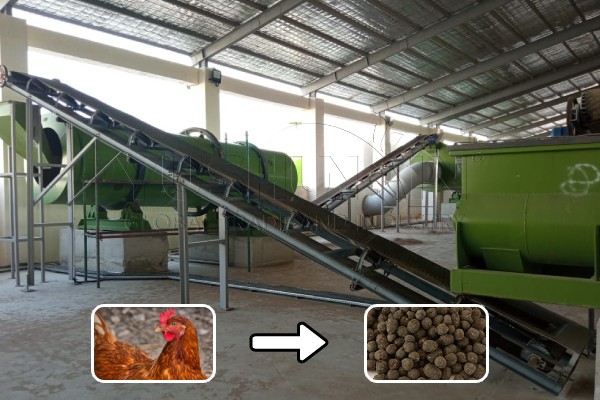
The clearer your product goal is, the easier it becomes to choose the right technical setup.
Choose the Right Granulation Machine
The granulator is the heart of the whole line. For small and medium-sized projects, a suitable chicken poop organic fertilizer granulation machine can help transform fermented manure into uniform particles with good strength and appearance.
For larger fertilizer plants, output capacity becomes more important. In that case, a rotary drum granulator for chicken poop fertilizer pellets making is often a practical option because it supports continuous operation and handles larger volumes efficiently. This type of equipment is especially useful when stable production and consistent pellet quality are required.
Consider Automation Level
Labor cost and management efficiency are also important factors. A semi-automatic line may be enough for a farm with lower production volume and available workers. However, if you run a commercial fertilizer plant, an automatic chicken manure granulating system can improve efficiency, reduce labor dependence, and maintain more stable product quality.
Automation can also help with feeding, conveying, screening, and packaging, making the whole process smoother and more reliable.
Think About Space and Future Expansion
When planning your production line, do not focus only on current needs. You should also consider plant layout, available workshop space, electricity supply, and future expansion plans. A well-designed system can save installation costs now and make upgrades much easier later.
If you expect your fertilizer business to grow, it is wise to leave room for additional equipment or higher-capacity units in the future.
Final Thoughts
The best granulation setup depends on your farm size, manure supply, product goals, labor situation, and investment budget. Small farms often benefit from simpler solutions, while large fertilizer plants usually need more advanced and automated systems.
By carefully comparing your options, you can build a practical and efficient production line that turns chicken manure into valuable organic fertilizer and creates long-term economic benefits. If you need customized solution, you can visit https://www.granulatedcompostsolutions.com/product/chicken-manure-compost-pellets-production-solution/
No Responses