Modern mineral fertilizer production increasingly depends on stable and efficient granulation technologies. Among various fertilizer processing methods, disc granulating equipment plays a decisive role in transforming mined raw materials into uniform and durable granules. The manufacturing of rock-based fertilizers requires consistent particle size, strong mechanical strength, and controlled nutrient release. Each of these goals depends on precise granule formation during the production process. The disc granulator, also known as a pan granulator or pelletizer, creates spherical granules through controlled rotation and moisture adjustment. This process not only improves transportation and storage efficiency but also ensures that mineral nutrients remain stable during further processing and application.
What Types of Raw Materials Are Suitable for Mineral Fertilizer Manufacturing?
The production of rock-based fertilizers uses a wide range of mineral raw materials. Common examples include phosphate rock, potassium ore, dolomite, limestone, and magnesium-rich minerals. Each raw material provides distinct chemical and physical properties that influence fertilizer performance. In limestone fertilizer production, for example, finely ground limestone provides calcium and neutralizes soil acidity. In rock phosphate fertilizer production, the phosphate ore requires precise granulation to enhance solubility and nutrient availability. Potassium-bearing minerals, such as sylvite or langbeinite, form essential components for balanced nutrient formulations in the manufacturing of NPK fertilizer. Every industry—from mining to chemical processing—benefits from reliable granulation equipment because consistent granule quality supports smoother downstream handling, blending, and packaging.
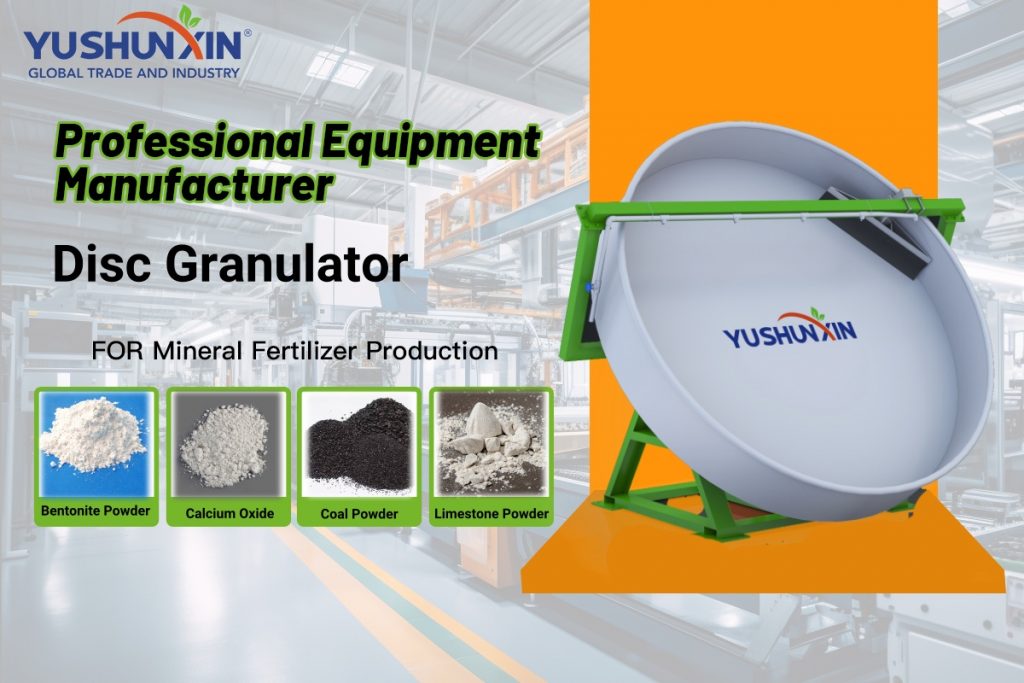
How Does Disc Granulating Equipment Support Mineral Granule Processing?
Disc granulating machinery provides an adjustable and observable granulation environment. The rotating pan continuously lifts and rolls mineral powder under controlled moisture and binder addition. The combination of motion and material layering promotes uniform particle growth and reduces dust formation. This disc or pan pelletizer allows flexible control of granule diameter and density by adjusting rotation speed, tilt angle, and feed rate. When compared with drum granulators or extrusion pelletizers, the disc-type granulating machine ensures higher visibility and easier operation. It suits complex mineral compositions like those found in mine waste management or mineral organic fertilizer production lines. Because each mineral particle undergoes granule-by-granule shaping, the resulting pellets present excellent uniformity and mechanical durability.
What Supporting Equipment Strengthens the Overall Production Line?
A professional mineral fertilizer manufacturing line typically integrates several types of equipment around the granulating stage. The ore fertilizer crusher machine or jaw rock crusher prepares the mined material by reducing particle size and improving surface area. The raymond mill further refines mineral powders to enhance reactivity during granule formation. After granulation, a rotary screening machine classifies granules by size and removes fines or oversized particles. These coordinated machines together form a complete mineral fertilizer production process, ensuring that each stage—crushing, granulating, screening, and drying—achieves synergy. In complex production schemes such as bulk fertilizer blending plants or mineral-based NPK manufacturing, precise equipment cooperation guarantees consistent granule quality and production efficiency.
Why Do Different Industries Depend on Mineral Granulation Technology?
Mining operations, chemical producers, and environmental management enterprises all depend on reliable granulation processes. In the mining sector, granulation stabilizes fine mineral residues and supports sustainable mine waste management. Chemical producers rely on granule uniformity for efficient reaction control and reduced dust emissions. The environmental industry uses mineral-based pelletizing to convert rock powders or industrial residues into reusable fertilizer materials. Each of these sectors benefits from the same fundamental requirement—controlled granule formation. Therefore, advanced granulating machinery ensures stable product characteristics across diverse materials and production goals.
Conclusion
The manufacturing of rock-based fertilizers involves numerous mineral materials, complex production procedures, and strict quality requirements. Disc granulating equipment becomes critical because it connects raw mineral preparation with final granule formation. By providing stable operation, precise particle control, and flexible process adjustment, this equipment ensures high-quality mineral fertilizer granules suitable for various industrial applications. For enterprises seeking reliable solutions in limestone, phosphate, or mine-derived fertilizer production lines, cooperation with a professional fertilizer equipment manufacturer such as Yushunxin offers comprehensive technology and machine support for continuous and efficient mineral fertilizer manufacturing. You can visit: https://www.mineralfertilizerproductionsolutions.com/product/disc-granulator-machine/
No Responses