An industrial freeze dryer can support higher-value food products, longer shelf life, and new export channels. It is also a substantial capital investment. A quotation for the machine alone does not show whether the project will be profitable. The investment case must include preparation equipment, installation, utilities, packaging, working capital, operating costs, finished-product yield, and the price the market will actually pay.
This guide explains how to calculate payback and return on investment for a freeze-drying project so the purchase decision reflects the complete production system rather than a single equipment price.
Start with the Total Project Investment
The first investment figure should cover everything needed to reach stable commercial production. For a standalone dryer, this may include the industrial freeze dryer, loading equipment, spare trays, cooling, and commissioning. For a complete facility, it may also include washing, cutting, pre-freezing, conveying, packaging, and factory modifications.
Build a capital-cost list with these categories:
- Freeze dryer and vacuum and refrigeration systems
- Raw-material preparation and quick-freezing equipment
- Conveyors, tray handling, inspection, and packaging
- Electrical supply, cooling, drainage, and compressed air
- Shipping, insurance, duties, and unloading
- Installation, commissioning, training, and documentation
- Spare parts, laboratory checks, and initial consumables
- Contingency for factory changes and project delays
- Working capital for raw material, packaging, wages, and receivables
Small items can materially change the total. For example, a 50kg/batch fruit freeze-drying line cost case shows that the final project scope includes more than one dryer. Buyers should compare complete quotations on the same technical and commercial basis.
Separate Revenue from Cash Contribution
Revenue is not the same as the cash available to repay the investment. Start with saleable finished-product volume, not the nominal raw-material load. Water is removed during drying, and trimming, rejects, and quality downgrades reduce the amount that can be sold at the planned price.
Use this structure:
Saleable finished weight = raw-material input × finished-product yield
Revenue = saleable finished weight × achieved selling price
Then subtract the cash costs required to produce and sell the batch:
- Raw material
- Packaging and labels
- Electricity and cooling
- Direct labour
- Maintenance and consumables
- Quality testing and waste disposal
- Freight, commissions, and customer support where applicable
The remaining amount is the contribution available to cover fixed cash costs, debt service, tax, and the original investment. A high-profile selling price does not guarantee a good return if raw-material waste, energy use, or packaging costs are high.
Calculate Daily Output from the Actual Cycle
Freeze dryer capacity should be calculated using validated batch weight and the complete cycle time. A nominal 100 kg batch does not mean 100 kg of saleable output, and the drying cycle does not end when the heating stage stops. Loading, unloading, cleaning, and changeover also consume production time.
Use the freeze dryer capacity guide to define shelf area and raw-material loading. Then adjust the result with product trials and yield data.
Completed batches per day = available operating hours ÷ complete cycle block
Daily raw input = completed batches × usable raw load per batch
Daily saleable output = daily raw input × finished-product yield
If demand is seasonal, use a realistic annual operating pattern rather than assuming full capacity every day. Payback calculations based on 365 days of perfect output can make an average project appear more attractive than it is.
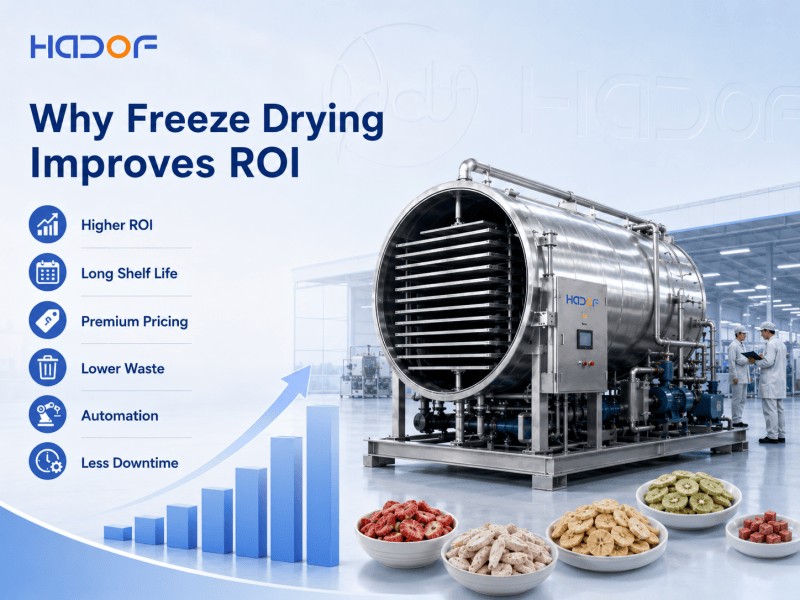
HDF Industrial Freeze Drying Facility improve factory ROI
Build a Monthly Cash-Flow Model
A simple monthly model helps separate operating performance from financing and accounting adjustments. Begin with the number of production days, batches per day, saleable output, and contribution per kilogram.
The core formulas are:
Monthly contribution = saleable kg per day × contribution per kg × production days
Monthly operating cash flow = monthly contribution − fixed cash costs
Payback period in months = total project investment ÷ monthly operating cash flow
ROI = annual operating cash flow ÷ total project investment
For more detail, include a ramp-up period, maintenance reserve, tax, loan payments, and working-capital changes. A project may have positive accounting profit while running short of cash because inventory and customer payment terms absorb money.
Include the Full Operating Cost
Freeze drying usually has higher energy demand than simple hot-air drying because refrigeration, vacuum, and condensation operate over long cycles. Energy use should be based on measured or supplier-supported consumption for the actual product and batch.
Maintenance also belongs in the model. Vacuum pumps, refrigeration equipment, seals, filters, sensors, and trays require inspection and replacement over time. The factory should reserve funds for parts and technical support instead of treating maintenance as an unexpected cost.
Labour can change significantly with automation. Manual tray preparation may be appropriate at low volume, while larger plants may justify conveyors and automatic transfer. Evaluate labour savings alongside the equipment cost and required technical skills.
Account for Yield, Quality and Market Risk
The best operating result depends on product quality that customers will consistently buy. Poor colour, broken pieces, uneven moisture, or packaging failures can reduce the sellable yield even when the dryer is mechanically available.
Test assumptions for:
- Raw-material price and seasonal availability
- Finished-product yield
- Achieved selling price after discounts
- Energy consumption per batch
- Percentage of seconds or rejected product
- Capacity utilisation and order continuity
- Packaging and freight costs
- Maintenance and spare-part inflation
Run a conservative case as well as the base case. If payback becomes unacceptable when the plant runs at a lower utilisation rate or the selling price falls, the project may be too sensitive to market changes.
Compare Equipment on Life-Cycle Value
The lowest purchase price is not automatically the best investment. A machine with unstable vacuum, poor temperature uniformity, slow loading, or difficult maintenance may reduce saleable output and increase operating cost. Conversely, extra automation that is not used can increase capital without improving cash flow.
A complete freeze-drying production line should be evaluated as one system. Match the capacity of preparation, freezing, drying, and packaging to the same production schedule. Identify the bottleneck and calculate the return on the complete line, not only on the dryer.
Freeze Dryer ROI Checklist
- Use total delivered project cost, not machine price alone
- Include installation, utilities, working capital, and contingency
- Confirm usable batch loading and validated cycle time
- Calculate saleable finished-product yield
- Use a realistic selling price and order volume
- Include energy, labour, maintenance, and packaging
- Model ramp-up, reject rate, and seasonal utilisation
- Calculate monthly cash flow, payback, and annual ROI
- Test lower-price and lower-utilisation scenarios
- Compare equipment on throughput, quality, and life-cycle cost
For a project-level calculation based on your product, capacity, utilities, and target market, contact HADOF Food Processing Manufacture with your raw material, planned output, investment scope, and finished-product specification.
No Responses