A fruit snack maker, a pet food producer, or a pharmaceutical food plant that runs a freeze dryer often finds that the accessory set decides both the drying quality and the long run operating cost. The freeze dryer accessories price for commercial food production covers the cold trap, compressor, vacuum pump, condenser, and heat exchange parts, and a buyer should measure those costs against the uptime and quality they protect. This article explains the cost items and the simple way to estimate a return on the food machinery investment.
Which Accessory Costs Belong in the ROI Calculation?
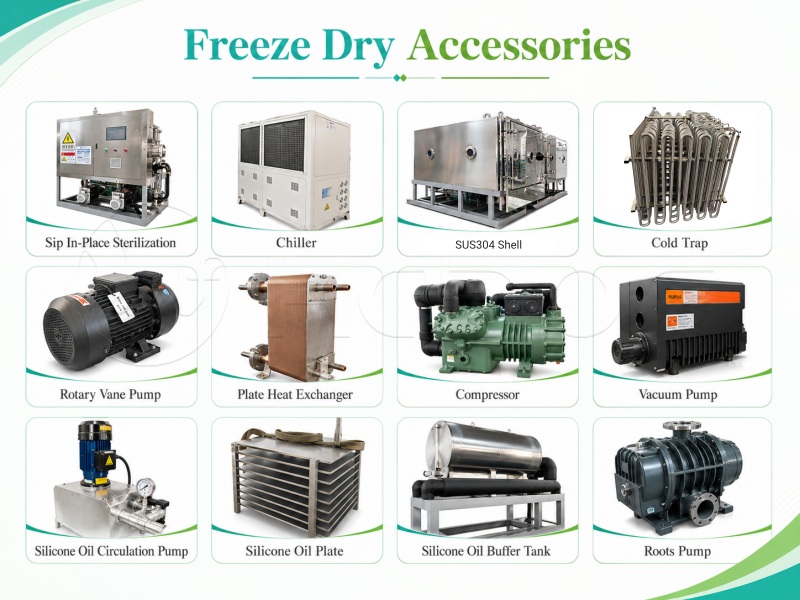
An ROI calculation starts with the delivered cost of the accessory set, not only the list price, and then adds installation, replacement cycles, and the energy each part draws. The industrial freeze dryer accessories with a cold trap and vacuum pump include the cold trap that captures water vapor, the compressor that holds vacuum pressure, and the condenser that cools the system. A buyer also counts the labor and downtime that a failed part causes. These items turn a loose food cost estimate into a figure the plant can defend.
How Does the Cold Trap Affect Drying Efficiency and Payback?
The cold trap sets the low-temperature area where water vapor condenses, so its size and material decide how fast a batch dries. The freeze dryer maintenance parts for food processing plants use stainless steel cooling pipes rather than aluminum, because stainless steel resists oxidation and a larger capture area keeps drying stable. A small cold trap can let partial melting occur during sublimation, which shrinks or deforms the product and adds rework. A factory that chooses a properly sized cold trap therefore shortens each cycle and improves the food manufacturing payback.
How Do the Compressor and Vacuum Pump Shape Operating Cost?
The compressor and vacuum pump work together through the whole drying cycle, so their reliability and energy use repeat in every batch. The compressor holds the low pressure while water vapor rises during the main drying stage, and the vacuum pump removes deep moisture and protects the product structure. A weak or inefficient pair lengthens the cycle and raises electricity use, while a stable pair keeps the food production line predictable. A buyer who records cycle time and power sees these accessories as an operating cost lever, not just a replacement part.
How Does a Reliable Accessory Set Reduce Rework and Downtime?
A failed accessory stops the whole freeze dryer, and the cost of that stop usually exceeds the part price. A reliable set of cold trap, compressor, vacuum pump, condenser, and silicone oil heat exchange components keeps the freeze dryer for a food processing line running without a partial-melt or deformed batch. Fewer reworked batches and fewer emergency stops mean the accessory investment returns through avoided loss. This reliability is the hidden saving that a simple food processing ROI calculation often misses.
How Should a Plant Measure Payback Months for Accessories?
Vacuum pump and cold trap performance appear in cycle time and yield, so a plant can estimate payback by dividing the accessory cost by the monthly saving from shorter cycles and fewer rejects. You can review the freeze dryer accessories manufacturer before a purchase, because spare parts and service decide how fast a replacement arrives. A measured payback turns the food machinery decision from a guess into a budget the plant can approve.
Conclusion
A freeze dryer accessories ROI follows the cold trap, compressor, vacuum pump, condenser, and heat exchange parts, and a buyer measures those costs against shorter cycles, lower energy, and fewer rejected batches. These checks protect the food production budget. If you have interests, you can learn more about https://www.hadofps.com/products/freeze-dry-accessories/
No Responses