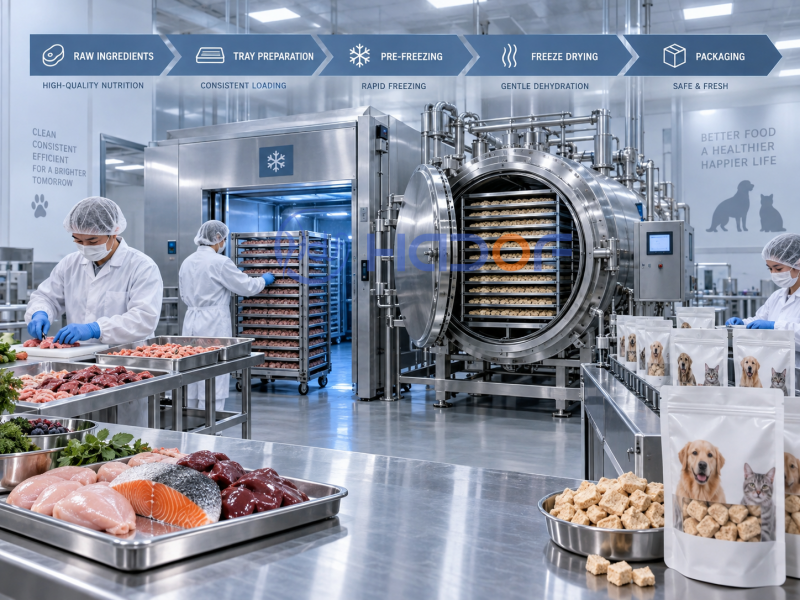
Pet food raises the stakes on every step before the freeze dryer. Meat and organ recipes carry high protein and fat, and they lose quality fast at room temperature. A plant that treats pet food like ordinary dried snacks pays for it in texture, aroma, and returned goods. A purpose-built freeze-dried pet food production system keeps raw material, freezing, loading, and packing in step, so each batch holds the same standard as the last.
Start From the Raw Material Reality
High-protein recipes behave differently from fruit or vegetable loads. Fat carries flavor, but it also softens structure and slows sublimation where it concentrates. Raw meat mixtures also give bacteria a short window, so the line must move product from mixing to freezing without long stops. Plan the recipe, the piece size, and the tray depth around that window. When the front end feeds the freezer at a steady rate, the freeze dryer receives product with the same history every time, and repeatable drying becomes possible.
Keep Pre-Freezing Ahead of Loading
Pre-freezing sets the ceiling on batch quality. An industrial tunnel freezing machine pulls each tray through a continuous cold zone, so the product core hardens at the same pace across the whole tray. Slow or partial freezing forms large ice crystals that tear the meat structure, and the dried piece then turns crumbly instead of tender. A tunnel also acts as a buffer between mixing and drying: trays queue in the cold instead of waiting warm on a bench, so the loading station never pushes half-frozen product into the chamber.
Match Loading Depth to the Product
Loading depth decides how vapor escapes during drying. Chunky meat cubes hold more water per tray than small kibble-style pieces, so the same fill height behaves differently across recipes. Fill each tray to a fixed depth for each product, spread pieces evenly, and keep that setting through the whole campaign. A half-empty tray wastes shelf area, and an overloaded tray dries unevenly while the vacuum system works harder. Align tray filling with chamber unloading so the industrial freeze dryer always receives a full, even load at a steady rhythm.
Close the Gap Between Unloading and Packing
Dried pet food leaves the chamber brittle and thirsty for moisture, and its fat content reacts with oxygen in open air. Every extra minute on an open tray costs aroma and shelf life. Position the packing station close to the chamber exit, prepare film and containers before the cycle ends, and move product straight from tray to bag. A reliable food packing machine seals each batch quickly and keeps the headspace dry, so the quality built inside the chamber survives on the shelf.
Balance the Three Stations as One System
Loading, freezing, and drying work as one clock. If the freezer outruns the chamber, trays stack up and thaw; if the chamber outruns packing, finished product sits exposed. Hadof designs freeze-dried pet food production systems around your recipe, batch size, and floor plan, so the three stations run at matched speeds from day one. To discuss a customized pet food freeze-drying solution, visit the Hadof freeze dryer homepage at https://www.freezehadof.com/.
No Responses