Small snack factories often see color variation when samosas and falafel enter hot oil with different sizes, moisture levels, surface conditions, or feed spacing. A mini continuous fryer for samosas and falafel production gives processors a controlled conveyor path instead of relying on repeated manual batches. The machine regulates oil temperature, conveyor speed, and frying time, so a factory can build a more repeatable food frying process around a defined recipe. Samosas need stable heating across dough layers and filled centers, while falafel needs controlled surface browning without excessive darkening. A compact continuous system can also connect with forming, filling, deoiling, cooling, seasoning, freezing, or packaging equipment when a growing processor needs a coordinated food production line.
Why Do Samosas And Falafel Show Uneven Color In A Small Continuous Frying Process?
Samosas and falafel create different heat-transfer challenges even when one factory fries both products. Samosa wrappers contain layered dough around a filling, so wrapper thickness, seam shape, filling temperature, and surface moisture affect browning. Falafel relies on a chickpea or fava bean mixture with its own moisture, particle size, and forming density. The common description of falafel made from chickpeas or fava beans helps explain why formula and structure influence frying behavior before equipment settings even enter the calculation. Uneven feed spacing also changes local oil temperature because a dense product load absorbs heat faster than a light load. A consistent food preparation procedure therefore starts with portion control, forming consistency, drainage, and even conveyor loading. The fryer can then manage time and temperature around a more stable incoming product instead of compensating for uncontrolled raw-material variation.
How Does Falafel Frying Temperature Control Work With Conveyor Speed And Residence Time?
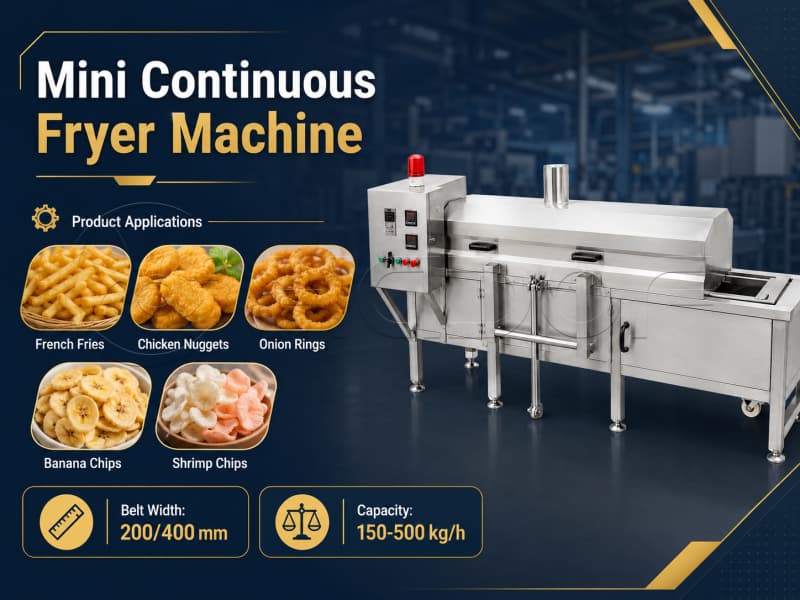
Falafel frying temperature control depends on the relationship between oil heat and residence time rather than on one temperature setting alone. The mini fryer uses a stainless-steel conveyor, while the control panel regulates frying temperature, conveyor speed, and processing time. Hadof lists standard mini-fryer frying times from about one to five minutes, depending on configuration and product requirements. A compact conveyor fryer for small fried snack factories lets processors slow the belt when a dense falafel piece needs more internal heating or increase conveyor speed when a smaller product reaches the desired crust sooner. The same logic supports samosa color consistency because wrapper thickness and filling mass influence heat demand. Operators should establish one recipe for each product size and load pattern, then keep feeding density stable. This food production technology gives the factory a practical way to repeat color, crispness, and cooking time from one production period to the next.
Why Does A Continuous Fryer For Floating Foods Need Stable Conveying?
Floating or irregular products can drift, overlap, or expose different surfaces to oil when a frying line cannot control their movement. Falafel pieces, samosas, fritters, coated vegetables, and some dough snacks can therefore show color differences even when the oil temperature remains stable. A larger continuous frying system for floating and irregular foods uses upper and lower mesh belts to keep products more steadily inside the oil layer, and the system lets customers adjust the belt gap for different product thicknesses. The mini-fryer page does not state that every compact model includes a hold-down belt, so a buyer who needs a hold-down conveyor fryer should confirm that configuration during equipment selection. This distinction matters for food handling equipment because product buoyancy, coating fragility, and thickness determine whether one belt can manage movement or whether a second belt improves control.
How Can A Small Samosa Frying Line Improve Color Consistency Without Adding Excessive Complexity?
A small samosa frying line gains consistency when the factory controls several simple variables together. The process team can standardize samosa weight, wrapper thickness, filling temperature, feed spacing, oil temperature, and conveyor residence time. The fryer then gives each piece a more similar heating history. A small continuous frying machine with adjustable belt speed supports this approach because variable conveyor movement controls how long products stay in the frying chamber. The mini fryer also includes digital oil-temperature control, a bottom scraper for larger particles, optional filtration for smaller crumbs, and a lifting design that improves access to the oil tank and mesh belt. Those features support food manufacturing process control because burnt crumbs can darken the oil and affect finished color. The Fried Food Solutions equipment overview also shows how frying equipment connects with preprocessing and post-treatment machinery for broader snack production projects.
Which Mini Continuous Fryer Configuration Fits MENA And East Africa Samosa And Falafel Production?
MENA and East African snack processors often need compact machinery that handles several fried foods in one workshop. The mini fryer page lists samosas and falafel among products for Middle Eastern, North African, South Asian, and African processing markets. Hadof lists standard capacities from about 150 to 500 kg/h and common mesh-belt widths of 200 or 400 mm for its mini continuous fryer range. An automatic mini fryer for MENA and East African snack lines can therefore suit pilot plants, central kitchens, growing snack factories, and processors that plan several products on one fryer. Project teams can match fryer length, conveyor width, heating method, oil filtration, and residue collection to actual recipes and working hours. The equipment quotation should reflect product dimensions, required throughput, local energy conditions, available floor space, upstream forming or filling, and downstream deoiling or cooling. This food processing system approach helps investors control investment budget while keeping room for future production expansion.
How Do Oil Management And Cleaning Influence Samosa Color Consistency And Falafel Quality?
Oil condition affects color because crumbs, flour, filling leakage, and small falafel particles can remain in the fryer and continue browning. The mini fryer uses a bottom scraper for larger particles and can add filtration for smaller suspended residue. A factory should combine residue removal with scheduled oil checks, consistent loading, and regular cleaning so the food frying technique does not rely on temperature control alone. The lifting system improves access to the conveyor and oil tank, which supports routine sanitation and food waste disposal management. A processor that changes between samosas, falafel, fried vegetables, or coated snacks should also consider cross-product residue and seasoning carryover during production planning. Stable oil management supports more repeatable color and flavor while reducing the risk that old crumbs influence the next product run.
What Is The Best Way To Build A Repeatable Mini Frying Process For Samosas And Falafel?
A repeatable process starts with consistent product preparation and then uses fryer controls to maintain the recipe. Samosa factories need stable wrapper and filling conditions, while falafel factories need consistent mixture moisture, portion size, and forming density. The fryer then controls oil temperature, conveyor speed, residence time, residue removal, and discharge. Small food manufacturers can review the mini fryer configuration when they compare capacity, belt width, cleaning access, filtration options, and line connections. If project teams have further interest in compact frying equipment for samosas, falafel, and other regional snacks, they can learn more about the machine here: https://www.friedfoodsolutions.com/mini-continuous-fryer-machine/
No Responses