Interest in establishing an NPK liquid fertilizer production line has been growing in recent years, especially among companies seeking flexible, fast-turnover fertilizer products. Whether referred to as a liquid NPK manufacturing system, an NPK fluid fertilizer plant, or a water-soluble nutrient blending unit, the core question remains the same: How much does it cost to set one up?
Below is a practical, data-based breakdown suitable for investors and producers evaluating their first project.
- Raw Material Inputs: The Largest Variable Cost
For most producers, raw materials take up 45%–60% of the total operational cost of liquid NPK fertilizer line. A typical liquid NPK formulation line uses:
Soluble nitrogen sources (urea, ammonium nitrate, etc.)
Potassium salts
Chelated micronutrients
Water and stabilizers
Market fluctuations have a direct impact on production cost. For example, potassium materials alone can swing by 15%–30% year-to-year, so many plants incorporate storage tanks to buy in bulk when prices are low.
- Equipment Investment: Core Setup Cost
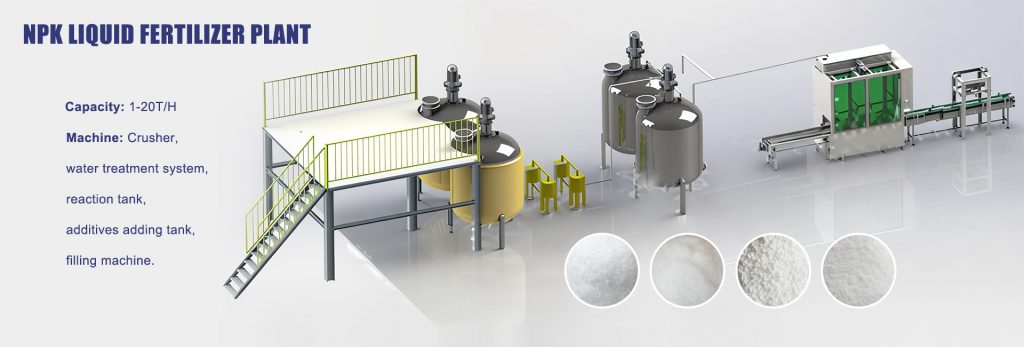
The machinery required for an NPK liquid fertilizer mixing line is relatively compact compared with solid-granule factories, but equipment quality still influences overall cost and productivity. A basic setup usually includes:
Liquid batching and weighing system
Dissolving or chelation reaction tank
Mixing and homogenization tank
Filter unit (bag filter or dynamic filtration)
Storage and filling system
A standard liquid NPK production unit for small to medium output (1–10 T/H) usually costs $25,000–$150,000, depending on automation level and tank configuration. Stainless-steel reaction tanks account for nearly 40% of total equipment expenses.
- Labor and Utilities
Operating a liquid nutrient formulation plant requires fewer workers than granulation lines. Many small systems run with 2–3 operators per shift. Electricity costs mainly come from agitators and pumps, while heating is minimal unless the formulation requires warm dissolution.
For reference:
Utilities: 5%–10% of yearly cost
Labor: 10%–18%, depending on region
- Facility & Compliance Expenses
A liquid NPK fertilizer factory requires a smaller footprint—often 200–400 m² is enough for a compact line. Ventilation, sewage pretreatment, and chemical-handling compliance add to the initial setup. These typically account for 10%–15% of total investment.
- Why Many Investors Choose Modular Equipment
For new entrants, modular systems offer:
Short installation time
Flexible capacity expansion
Lower operational risks
Many manufacturers now choose standardized liquid NPK fertilizer production skids, which can be upgraded with automatic dosing, inline monitoring, or microbial-strain injection.
If readers are planning to build a system or need a reference layout, a technical team can provide equipment selection suggestions, budget estimates, and line configuration based on intended formulas and output capacity. If you need a business plan, welcome to visit: https://www.liquidfertilizerplants.com/products/npk-liquid-fertilizer-production-line/
No Responses